なお、著者の普段の思索をまとめたエッセイ集を、先日Kindle Direct Publishing(KDP)より刊行しました、『空の記憶:空と人生をめぐる随想』(The Sky of Life: Reflections on Time, Memory, and the Sky (English version)です。
In my latest book, Life and Language, I explore the dynamism of consciousness by integrating psychology and philosophy.
Contrary to conventional cognitive theories where “integrated features form an object,” I propose that “predicative reception precedes subjective integration.” This means our neural circuits do not merely perform “computations”; rather, they depict our perception much like a poet weaving logos (logic/word) out of pathos (emotion/experience). This transition from the “predicative” to the “subjective” reflects the fundamental process of how our lived experience acquires meaning.
Main Work:A Life and Language: Searching for the Linguistic Integration of Science (Hokuju Shuppan, 2025)
New Release:The Sky of Life: Reflections on Time, Memory, and theSky (KDP, 2026) — A more introspective and personal collection of essays. [Amazon.com/Amazon.co.jp]
This handout was prepared for a presentation at the workshop on Attention and Cognition (Nagoya, March 9, 2026). It is provisional and reflects my current line of thought.
The presentation addresses the problem of how a unified “subject” (first-person perspective) emerges from distributed information processing in the brain, a question that remains unresolved within standard parallel distributed processing (PDP) models.
I propose to reinterpret cognitive processes as a dynamic repetition of dispersion and integration of information, and to formalize this process using the concept of a meta-attractor. While conventional attractors account for convergence toward specific representations (e.g., recognizing an object), they cannot explain the persistent form of “being experienced by me.”
The meta-attractor is not a convergence point toward a particular content, but a higher-order dynamical stability that sustains the iterative process itself. It provides a global structure within which dispersion and integration can continue without collapsing into chaos, thereby generating a stable first-person structure.
Within this framework, distributed processing corresponds to a predicative (second-person-like) phase of receptivity, while integration corresponds to the emergence of subjectivity. The subject is not presupposed but arises retrospectively as a structural center of this dynamic process.
This model also suggests a new dynamical perspective on psychopathology, where disturbances of selfhood may be understood as instabilities in the formation or maintenance of the meta-attractor.
Philosophically, the model resonates with Quine’s holism and offers a naturalized account of transcendental subjectivity, describing the “conditions of possibility” of experience in dynamical and cognitive-scientific terms.
(This handout is provisional and is shared here for further development and discussion.)
わたしの哲学的探求は、二人称が人称的対立(一人称 vs. 三人称)の和解となるという発想から始まり、〈二人称―媒介性―受容性―述語性〉という概念連関を辿って、二人称を述語性として読み替えることにより、述語・主語結合が、述語性による主語性の embrace(包容)によって成立するという理解に結実していきました。
Reflecting on this period as we move from Christmas toward the New Year, I find myself thinking about the fact that this past year has seen far too many deeply painful events unfold around the world.
This suffering is also the suffering of Christ. Yet, precisely because of this, the faint light of hope is never extinguished, even in the deepest darkness. That is why, even in such a world, we are able to share heartfelt gratitude and joy. I was once again reminded of the true meaning of Christmas.
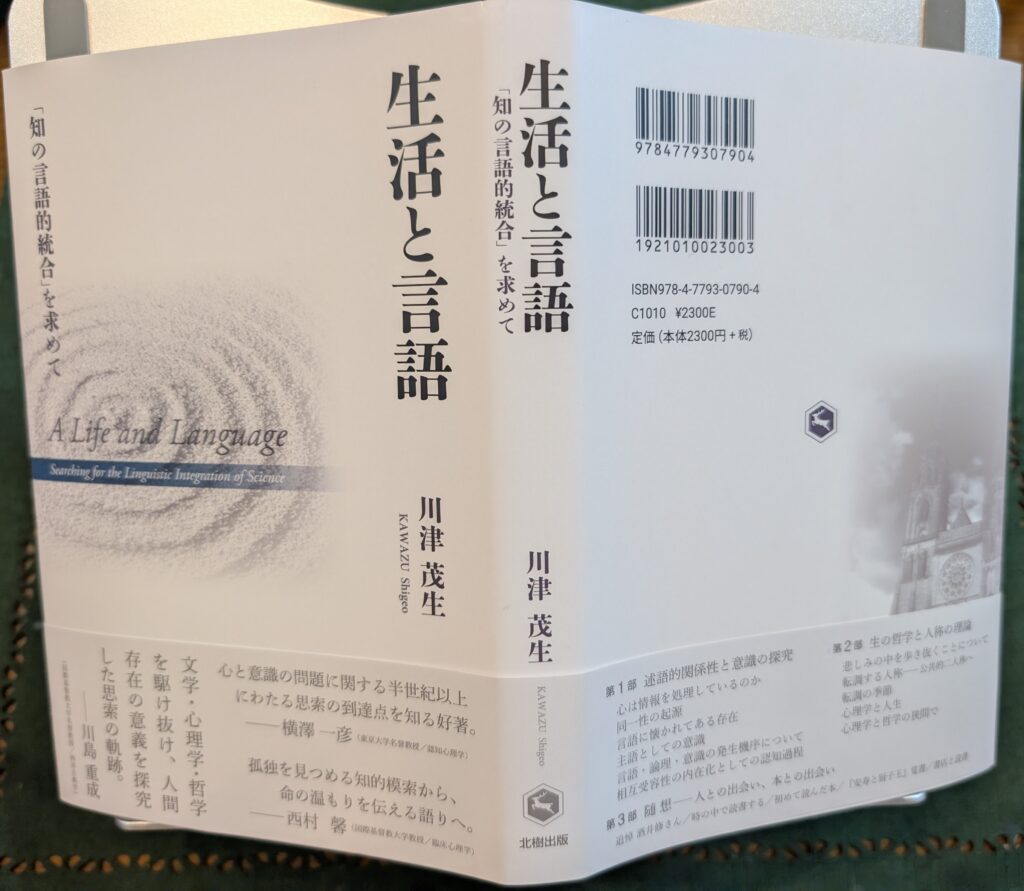
Now, in this season of prayer, I have an announcement to make. My new book, A Life and Language: Searching for the Linguistic Integration of Science (Hokuju Shuppan), has officially been released.
It has been five years since the publication of my second volume, ALife and Logic: Searching for Logos of Grammatical Person (2020), and I am relieved to finally be able to bring this work to you.
My philosophical inquiry began with the idea that the “second person” serves as a reconciliation of the personal opposition between the first and third persons. By tracing the conceptual chain of <Second Person — Mediation — Receptivity — Predicativity>, and by reinterpreting the second person as “predicativity,” my thought crystallized into an understanding: the union of subject and predicate is established through the embrace of subjectivity by predicativity.
This understanding theoretically clarifies the formation process of the subject-predicate form. The subject is embraced by predicativity—which is, in essence, second-person receptivity—and through this embrace, the subject-predicate union is generated.
What is crucial to note here is that this “embrace” by predicativity is also an embrace by compassion (Jiai). Therefore, for subjectivity to be enveloped by predicativity means, in other words, that subjectivity is enveloped by the compassion of predicativity, allowing the predicate and subject to become one.
Through this lens, we can understand that the establishment of a proposition via the subject-predicate form is not merely the creation of syntax. Rather, it is established as the very crystallization of meaning born from compassion.
Thus, my theory demonstrates that logic and meaning were originally one, and that their separation was never fundamental. I believe that many dualistic problems associated with the dissociation of logic and meaning can be resolved starting from this point.
Furthermore, this understanding also applies to information processing within the brain’s neural circuits. I have detailed this aspect in A Life and Language: Searching for the Linguistic Integration of Science.
This may have been a somewhat complex discussion, but I hope you can use it for a bit of mental gymnastics and intellectual stretching during this holiday season.
【Friday Night Philosophy 】Is the Brain’s <Language> the “House of Being”?
Good evening, this is Shigeo Kawazu. It is Friday night, December 12th. Here in the snowy north, the world is wrapped in the veil of a silent night. On such a night, it is not a bad idea to rest your tired brain and spend a quiet moment reflecting on “life and thought,” perhaps while staring at the flames of the stove or sipping a warm drink cradled in your hands.
Last time, I spoke about the “season of modulation” that visits both our lives and our neural circuits.
Inside our brains, information arriving from the outside world is received (this is the <third-person → second-person> stage). Then, through a process of distribution and integration, a “first-person” perspective is established. I have grasped this process as a “Modulation” of the mode of personhood.
In life as well, although the form differs, isn’t there a similar “modulation” where personhood shifts? Just as music suddenly transitions to a different key.
“Time transforms personhood.”
From the “first-person” of youth, clad in bravado, to the “second-person” of vulnerability and acceptance. And then, through further modulations, one becomes an “adult” capable of speaking calmly and rationally with anyone.
By the way, what is happening inside our brains during this time? Third-person information from the outside is first “accepted” (second-person) by the brain. At this stage, the information is still distributed, but as it becomes integrated, the “first-person” is generated.
In this series of processes leading up to integration, the brain speaks “words” as if it were writing a composition.
However, the “words” mentioned here are not the languages we know. It means that the brain’s information processing itself has a mode that is “Linguistic” (meaning-generating) rather than merely Logical.
The mode in which meaning arises through <words> is equipped in the brain’s most basic processing mechanism.
Here, I recall Heidegger’s phrase: “Language is the house of Being.”
For Heidegger, the <house> was the place where Being is disclosed. If the series of processes in our neural circuits is indeed the locus of “meaning generation,” then perhaps—even within the physical matter of the brain—there exists a <language> where Being is disclosed.
Perhaps neuroscience and phenomenology can be bridged in this way. On this quiet, snowy night, these are the thoughts drifting through my mind.
My new book, A Life and Language (Seikatsu to Gengo), which will soon appear in bookstores, holds the potential to continue these reflections and explores further questions that may arise from them. I look forward to the day when this book visits your own “house where Being is disclosed”—your brain.
More in the next article. Please stay warm and have a restful weekend.
[English Summary]Life’s Modulation: From the Strong “I” to the Receptive “You”
Friday Night Philosophy — A Crossover of Life and Meditations
Previously, I discussed how grammatical persons shift within the micro-world of neural networks. Tonight, let’s zoom out to the macro-world of “Life.”
Just as music modulates from a major key to a minor key, our lives experience shifts in deep underlying moods. I call this the “Season of Modulation” (転調の季節). Underneath these shifts lies a transformation of “Grammatical Person”:
Youthful Vigor: The “Strong 1st Person (I)” leads the way.
Times of Weakness: When the “I” is weakened by life’s hardships, we transform into a “2nd Person (You)” capable of accepting the pain of others (Receptivity).
Maturity: Through these changes, we awaken to the “3rd Person (Objectivity),” accepting our physical limits.
My theory serves as a compass for both brain mechanisms and life’s seasons. As I write this… a package has just arrived. My new book, A Life and Language, is finally here in my hands. (See photo above)
Neural Networks and Language: How the “I” Emerges from the “Third-Person” Brain
Friday Night Philosophy — A Crossover of Life and Meditations
In my previous post, I introduced the “General Theory of Grammatical Person” as a framework to bridge the gap between mind and science. To clarify, “General” here does not refer to the “general public,” but rather to a comprehensive theory covering the structure of all grammatical persons, akin to Einstein’s General Theory of Relativity.
Tonight, let’s connect this abstract theory to our daily lives. In life, when we face conflicts between ourselves (1st person) and society (3rd person), a “second person” (a mediator) often steps in to bridge the gap. This function is what I call “Receptivity.”
I propose that a similar process occurs within our brains. The brain receives scattered external information (3rd person) through a “second-person-like” receptivity. It then integrates this information, transforming it from a “predicate” state into a “subject” (1st person) state.
I describe this process as “the brain constructing sentences.” In this sense, our neural networks are not just processing electrical signals; they are constantly speaking “words” to generate consciousness.
This theory is not mere speculation but is rooted in my personal experiences—teaching nursing on “loneliness and connection,” analyzing the twists and turns of life through Sophocles’ Oedipus Rex, and facing my own hardships. Theory is born from life. By explaining the processes of resolving life’s problems, ideas ferment and mature into a coherent philosophy.
Toward a General Theory of Grammatical Person: Bridging the Gap between Mind and Brain
This article outlines the trajectory of my philosophical inquiry, which culminates in my upcoming book, A Life and Language: Searching for the Linguistic Integration of Science(Vol. 3).
Initially, I identified a common structure underlying both the existential crisis of mental illness and the scientific crisis of the mind-body problem: the deep conflict between the First-Person perspective (lived experience/phenomenology) and the Third-Person perspective (objective observation/science). To resolve this dichotomy, I proposed the necessity of the “Second Person” as a mediator. In existential terms, this manifests as the “Anticipatory Second Person,” which emerges when one transcends the desire for self-salvation to focus on the salvation of others.
However, applying this concept to the scientific problem of consciousness and the brain required a more rigorous framework. Simply asserting the importance of the “Second Person” is insufficient to explain how subjective consciousness arises from the material brain.
To address this, I developed the “General Person Theory” (General Theory of Grammatical Person). This approach requires us to step back from the specific, entrenched stances of phenomenology (purely first-person) and science (purely third-person). By examining “personhood” from a meta-level, general perspective, we can place all grammatical persons on a fair and equal theoretical footing.
While this General Theory successfully validated the structural necessity of the Second Person as a mediator, a difficult question remained: How exactly does the Second Person function within the neural circuits of the brain?
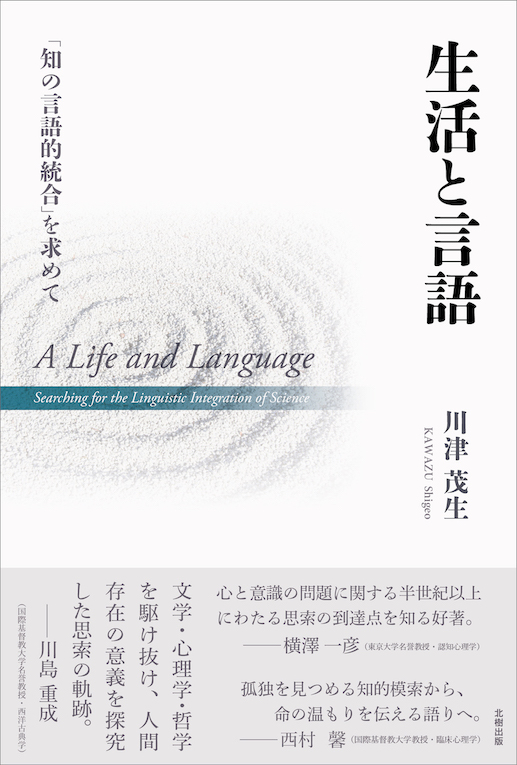
The theoretical framework was complete, but the concrete mechanism of how neural activities (third-person) are mediated to generate consciousness (first-person) remained elusive for many years. The solution to this final puzzle—involving the linguistic interpretation of neural network dynamics—is fully detailed in the concluding volume of my trilogy, 『生活と言語:「知の言語的統合」を求めて』(“A Life and Language: Searching for the Linguistic Integration of Science”), to be published in December 2025.
【著書のご案内 / Books】
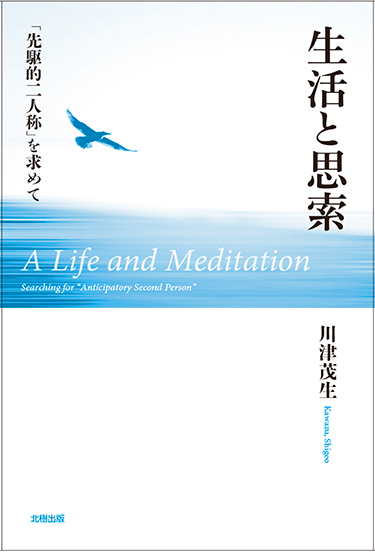
1. 『生活と思索:「先駆的二人称」を求めて』 (A Life and Meditation: Searching for “Anticipatory Second Person”) [Amazon][楽天]
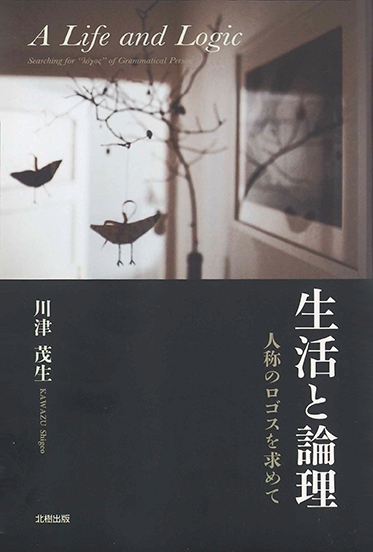
2. 『生活と論理:人称のロゴスを求めて』 (A Life and Logic: Searching for “logos” of Grammatical Person) [Amazon][楽天]
3. 『生活と言語:「知の言語的統合」を求めて』 (A Life and Language: Searching for the Linguistic Integration of Science) ※予約受付中[Amazon][楽天]
I presented a philosophical perspective on cognitive processes at the 23rd “Attention and Cognition” conference. This presentation offered a critical but respectful alternative to the information-processing model of cognition.
The main argument is that cognitive processes can be reinterpreted from a linguistic perspective. I propose that feature integration is not just a process of information processing but rather an integration of predicative descriptions by a subjective expression. This process, termed the “receptivity of receptivity,” is seen as the internalization of “mutual receptivity” between an organism and its environment.
I further argue that the repeated processing of this receptivity within the brain, particularly in neural networks, allows for the gradual emergence of logical structures from a pre-logical state. During this process, a certain degree of freedom is repeatedly applied, which transforms the “subjective expression” into a free subject or self-consciousness with free will and qualia.
This theory suggests that by viewing cognition through the lens of language, particularly its predicative and receptive aspects, it is possible to generate a more nuanced understanding of how consciousness and subjectivity emerge. I acknowledge that this philosophical framework requires rigorous psychological verification. This research is influenced by the Kyoto School of philosophy, aiming to reinterpret—rather than simply criticize—the achievements of information processing psychology.